A Dozen Digital Product Ideas You Can Build With AI in 2026
David Rhoderick//6 Min Read
A practical look at digital product ideas where AI creates real leverage in 2026 focused on durability, clarity, and responsible execution rather than hype.
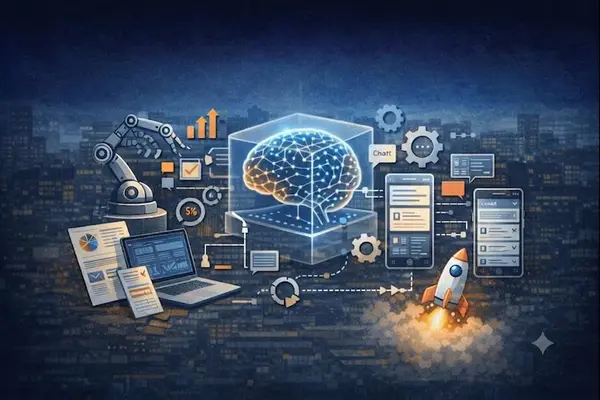
There’s no shortage of lists promising “easy digital product ideas.” Most of them recycle the same concepts, add a layer of hype around AI, and stop short of explaining what actually makes a product viable.
This piece takes a different approach.
Instead of treating AI as a gimmick, we look at digital product ideas where AI meaningfully changes what’s possible. Products that solve real problems, create leverage, and can be built responsibly without turning into brittle demos.
This is not about chasing trends. It’s about understanding where AI creates durable advantage.
Why AI Changes the Digital Product Landscape
AI lowers the cost of experimentation and increases the ceiling of what small teams can build. But it also raises expectations. Users now assume products will be faster, smarter, and more adaptive.
The opportunity is not “add AI to an existing product.”
The opportunity is to design products around:
- Automation where humans previously intervened
- Insight where data was previously inert
- Personalization where one-size-fits-all used to be acceptable
The best AI-driven products start with a problem, not a model.
What Makes a Strong Digital Product Idea in 2026
Before getting into specific ideas, a quick filter we use consistently.
Strong digital product ideas tend to:
- Solve a repeatable, painful problem
- Improve with usage over time
- Fit naturally into an existing workflow
- Create value even before they are “perfect”
AI can accelerate all of these, but it can’t replace clarity.
12 Digital Product Ideas Powered by AI
These ideas are intentionally broad enough to adapt, but specific enough to build.
1. AI Compliance or Risk Monitoring Tools
As software becomes more autonomous, oversight becomes more critical.
AI-driven risk and compliance tools can:
- Monitor activity across systems
- Flag anomalous or high-risk behavior
- Surface issues before they become incidents
These products succeed when they prioritize trust, auditability, and explainability over novelty.
2. AI Internal Knowledge Systems
Most organizations struggle not with a lack of data, but with fragmented knowledge.
AI-powered internal knowledge systems can:
- Connect documentation, decisions, and historical context
- Answer questions grounded in company-specific reality
- Reduce dependency on institutional memory
The value is not search. It is usable understanding.
3. AI Product Analytics Interpreter
Dashboards show what happened. Few explain why.
AI-driven analytics interpretation tools can:
- Translate metrics into plain language
- Highlight meaningful changes and their drivers
- Suggest where teams should investigate next
These products create leverage by reducing analysis paralysis and focusing attention.
4. Operations Software Built for a Single Business Model
Many businesses still rely on spreadsheets and email to run core operations.
AI-driven operations software can:
- Forecast demand
- Flag anomalies
- Suggest process improvements
The opportunity is deep specialization, not horizontal scale.
5. Industry-Specific CRM Software
Generic CRMs create friction because they try to serve everyone.
AI enables vertical CRMs that:
- Understand industry-specific language
- Automate data entry intelligently
- Surface next best actions based on context
The moat comes from focus, not features.
6. Financial Forecasting With AI Insights
Forecasting tools often fail because they present numbers without interpretation.
AI-enabled forecasting products can:
- Model scenarios dynamically
- Explain drivers behind changes
- Highlight risk before it materializes
Clarity beats complexity.
7. Customer Support AI Agent
Support automation only works when it respects context.
The next generation of support tools:
- Understand user history
- Escalate intelligently
- Learn from outcomes, not just scripts
The goal is resolution, not deflection.
8. AI-Enhanced Lead Research and List Builder
Manual lead research is slow and error-prone.
AI-driven tools can:
- Identify qualified prospects
- Enrich data intelligently
- Surface signals that indicate buying intent
Trust and accuracy matter more than scale.
9. AI Sales Assistant
A product that listens to sales calls, analyzes patterns, and surfaces coaching insights in real time.
The value is not transcription. It is decision support.
Used well, this kind of product helps teams improve outcomes without increasing headcount.
10. AI Designer for Marketing Teams
Design tools that generate layouts are common. Tools that understand brand constraints are not.
An AI design assistant that:
- Learns brand systems
- Adapts designs to channels automatically
- Reduces repetitive production work
Creates leverage without replacing human judgment.
11. AI Writer for Marketing
The strongest writing tools do not replace voice. They protect it.
Products in this category succeed when they:
- Enforce tone and style guidelines
- Reduce blank page friction
- Assist with iteration, not just generation
The value is consistency, not volume.
12. AI-Based Coaching and Learning Platforms
Personalized learning is one of AI’s most promising applications.
Products in this space work when they:
- Adapt to individual progress
- Balance automation with human insight
- Measure outcomes, not just engagement
Depth beats novelty.
How to Start Turning an Idea Into a Product
Ideas are cheap. Execution is not.
A practical starting path:
- Validate the problem with real users
- Define a narrow first use case
- Build the smallest version that creates value
- Learn from behavior, not assumptions
AI accelerates this process. It does not remove the need for judgment.
Development Considerations That Matter
AI-driven products introduce new constraints.
Teams need to think about:
- Data quality and provenance
- Model behavior and failure modes
- Privacy and security expectations
- Long-term maintainability
Good products plan for these early, even if solutions evolve.
The Future of AI in Digital Products
The most successful AI products in the next few years will feel boring on the surface.
They will:
- Work reliably
- Respect user trust
- Improve quietly over time
Flashy demos will fade. Useful systems will last.
How SeeSaw Labs Thinks About AI-Driven Products
We do not start with models. We start with intent.
Our role is to help teams:
- Decide what to build and why
- Design products that integrate naturally into real workflows
- Make technology choices that support long-term success
Sometimes that means using AI aggressively. Sometimes it means using it sparingly.
The goal is always the same: reduce chaos, increase clarity, and build products that matter.
Final Thoughts
AI has expanded what is possible in digital product development. It has not changed what makes products succeed.
Clear problems. Thoughtful design. Responsible execution.
The best ideas are not the loudest. They are the ones that quietly earn their place.