Fractional CTO For SaaS Startups: Scaling Reliability, DevOps, And Cloud Cost Control
SeeSaw Labs//12 Min Read
See how a fractional CTO helps SaaS startups improve reliability, mature DevOps, and control cloud costs without a full-time executive hire.

Most SaaS startups do not hit a wall because they stop building. They hit a wall because what helped them move fast early on stops working once customers, complexity, and expectations increase.
At first, the warning signs are easy to brush off. Releases take longer. Bugs take longer to isolate. Infrastructure bills rise faster than usage. Enterprise prospects ask harder questions about uptime, security, and operational maturity. The team is still moving, but it feels like more effort is producing less clarity.
That is usually the point where a founder or product leader starts asking a different question. Not, “Do we need more developers?” but, “Do we need stronger technical leadership?”
For many SaaS companies, that is where a fractional CTO becomes valuable. A strong fractional CTO for SaaS startups helps create the systems, decisions, and guardrails needed to scale with more confidence, without the cost and timing pressure of hiring a full-time executive too early.
Table Of Contents
- Why SaaS Startups Outgrow MVP Thinking
- What A Fractional CTO Actually Brings To A SaaS Startup
- Scaling Reliability Before Outages Become A Growth Tax
- DevOps Maturity That Helps Teams Ship Faster With Less Risk
- Cloud Cost Control Without Slowing Down Product Growth
- Signs You Need A Fractional CTO Now
- What The First 90 Days Should Look Like
- How To Choose The Right Fractional CTO Partner
- Why This Model Works Especially Well For B2B SaaS Startups
- FAQs
- Conclusion
- Key Takeaway
Why SaaS Startups Outgrow MVP Thinking
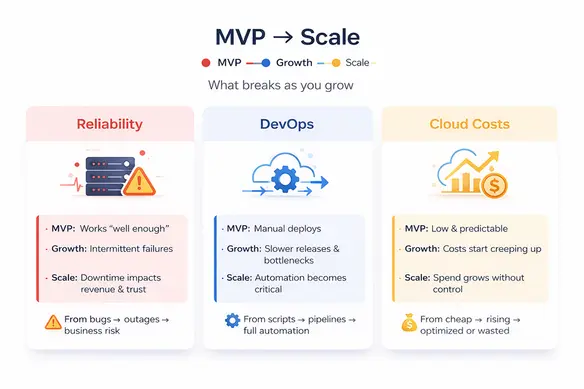
An MVP is designed to prove demand. It is not designed to carry long-term product, team, and customer complexity.
That creates a predictable tension. The architecture was good enough to validate the idea, but not necessarily good enough for scale. Delivery workflows may have evolved informally, with too much tribal knowledge and too few operational standards. Cloud decisions were made for speed, not cost efficiency. Monitoring may tell you something is broken, but not why it broke or how to prevent the next version of the same issue from occurring.
In the early stage, these compromises can be reasonable. In the next stage, they become expensive.
This is where technical leadership matters. Not because the company suddenly needs enterprise process everywhere, but because it needs the right amount of structure in the right places. A SaaS CTO, whether full-time or fractional, helps define what must be stabilized now, what can wait, and what is creating avoidable risk.
What A Fractional CTO Actually Brings To A SaaS Startup
A fractional CTO is not simply an external engineer with a better title. The role is about senior decision-making.
That includes translating business goals into technical priorities, setting a realistic architecture direction, improving delivery predictability, reducing operational risk, and helping the team make better tradeoffs. The value is leverage. Instead of reacting to isolated technical problems one by one, a fractional CTO looks at the system behind those problems.
For SaaS founders, this can be especially useful as they transition from early traction to operational maturity. There is enough momentum that weak decisions become costly, but not enough scale to justify a full-time executive hire.
A strong fractional CTO for B2B SaaS startups often works across several layers at once. They align roadmap decisions to product goals. They tighten DevOps and release workflows. They create visibility into reliability risk. They build better cloud cost discipline. They also help leadership understand where the real bottleneck sits, in architecture, process, team design, or priorities.
That is why the best engagements are not about advice alone. They are about turning technical ambiguity into a clearer operating system for growth.
Scaling Reliability Before Outages Become A Growth Tax
Reliability issues rarely begin with a dramatic outage. More often, they show up as small but compounding friction.
A page loads unpredictably under traffic. A background job fails and gets retried manually. A deployment causes side effects no one fully expected. Support tickets rise after releases. The team starts to slow down as confidence drops.
At that point, reliability is no longer an infrastructure issue. It becomes a product issue and a growth issue.
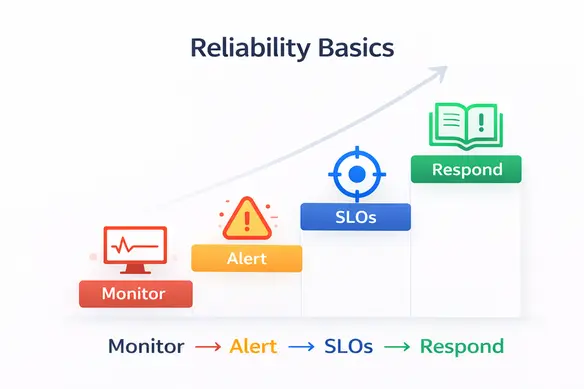
A fractional CTO helps by defining reliability as an operational discipline rather than a vague aspiration. That usually means clarifying service expectations, identifying critical dependencies, improving observability, standardizing incident response, and creating a process for learning from failures rather than repeating them. This is consistent with AWS guidance on resilient architecture and failure recovery, as well as Google SRE practices around SLOs and error budgets.
For SaaS startups, the goal is not perfection. The goal is predictability. Customers do not need you to eliminate all risk. They need to trust that the product is dependable, that issues are visible quickly, and that the team can recover without chaos.
DevOps Maturity That Helps Teams Ship Faster With Less Risk
Many teams treat DevOps as a tooling conversation. In practice, it is a conversation about delivery.
Good DevOps maturity is about making releases safer, faster, and easier to repeat. That includes build pipelines, deployment workflows, rollback readiness, test automation, environment consistency, access controls, and clear ownership across the path from code to production.
When this is weak, delivery becomes fragile. Engineers spend more time coordinating than shipping. Release days become stressful. Small changes feel high risk. Founders start hearing, “We can probably ship this next week,” far more often than they hear a confident yes or no.
A fractional CTO helps put the right discipline in place without overengineering the process. That may mean defining a cleaner CI/CD workflow, tightening branching and release rules, using infrastructure as code more consistently, or setting a small set of performance metrics for the team to review regularly. DORA’s guidance is useful here because it focuses on throughput and instability, including lead time, deployment frequency, failed-deployment recovery time, change-failure rate, and deployment-rework rate.
For a SaaS startup, this matters because delivery speed is only valuable when it is sustainable. Shipping faster while creating more incidents is not acceleration. It is deferred cleanup.
Cloud Cost Control Without Slowing Down Product Growth
Cloud cost problems are often symptoms of decision problems.
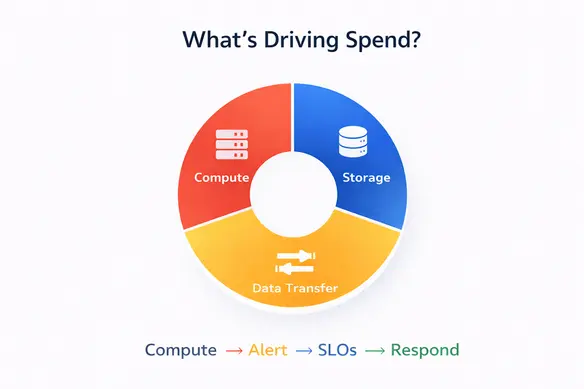
The team may lack visibility into what is driving spend. Environments may be overprovisioned. Storage and data transfer may be growing quietly. Workloads may not be rightsized. Engineering may not have cost ownership. Finance may see the bill, but not the why.
A fractional CTO can bring structure to that mess. That starts with visibility — what costs belong to which services, which environments, which customers, or which usage patterns. From there, the work becomes more strategic. Are you optimizing for speed, margin, customer experience, or all three? Which workloads deserve performance investment, and which should be simplified? Which costs are tied to real growth, and which are just waste?
This is where cost control becomes much more than discounts or reserved usage. It becomes part of the product and operating strategy.
That approach aligns with AWS cost optimization guidance and FinOps principles. Cost optimization is about achieving business outcomes at the lowest practical price point, while FinOps emphasizes shared accountability between engineering, finance, and the business, along with unit economics such as cost per active user, transaction, or API call.
For B2B SaaS startups in particular, this matters because margins, pricing confidence, and expansion plans all get harder when infrastructure spend behaves like a black box.
Signs You Need A Fractional CTO Now
Not every startup needs one immediately. But certain patterns are strong signals.
- Releases are slow, inconsistent, or stressful.
- Reliability issues are increasing, even though incidents remain manageable.
- Cloud spend is climbing, but the drivers are unclear.
- The product has outgrown MVP architecture decisions.
- Engineering priorities feel reactive rather than strategic.
- Founders are fielding technical questions from customers, prospects, or investors without enough internal support.
- The team is hiring engineers, but leadership and execution quality are not improving at the same pace.
- Enterprise buyers are increasingly asking about security, uptime, integrations, and operational readiness.
In many cases, the problem is not a lack of effort. It is a lack of senior technical focus.
What The First 90 Days Should Look Like
A good engagement should feel structured early.
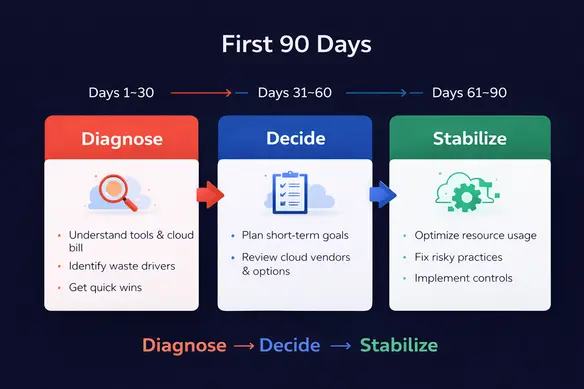
First 30 Days
The first month is about diagnosis and alignment. A fractional CTO should review architecture, delivery workflows, infrastructure, cost patterns, current team responsibilities, and product priorities. They should also align leadership around what matters most right now: speed, stability, cost control, hiring, or readiness for larger customers.
Days 31 To 60
This phase is about choosing and committing. Priorities become clearer. The team should have a documented direction for architecture, release improvements, reliability risk reduction, and cloud cost focus areas. The biggest bottlenecks should be visible, not hidden.
Days 61 To 90
This is where execution and stabilization begin to show up. Delivery hygiene improves. A few high-leverage technical decisions get made. Metrics become more visible. The team starts spending less energy on preventable friction. This general shape is also how SeeSaw Labs frames fractional CTO execution in its own guidance.
The goal is not to solve everything in one quarter. It is to create stronger momentum with less chaos.
How To Choose The Right Fractional CTO Partner
Not every experienced technologist is the right fractional CTO for a SaaS company.
You want someone who can think commercially, communicate clearly, and work across founders, product, and engineering without adding confusion. They should be able to simplify technical tradeoffs, not make them feel more abstract.
Ask practical questions:
- How do you approach the first 30, 60, and 90 days?
- How do you balance product speed with reliability and cost?
- What delivery metrics do you usually review?
- How do you help teams improve cloud cost visibility?
- Have you worked with B2B SaaS startups at our stage?
- How do you interact with founders, engineering managers, and external vendors?
- What should we expect to be different after one quarter?
The best answers are concrete. They connect business outcomes to technical decisions.
Why This Model Works Especially Well For B2B SaaS Startups
B2B SaaS companies often feel this need earlier than they expect.
That is because business customers bring different pressure. They care about reliability, security posture, implementation confidence, and operational trust. Even before a startup becomes large, it may already need to behave like a more disciplined software company in the areas that matter most to customers.
A fractional CTO helps bridge that gap.
This model gives startups access to senior leadership when decisions start carrying more weight, but before the business is ready for a full-time executive structure. It works well when the company needs maturity in architecture, DevOps, cloud economics, and leadership cadence, not just more engineering output.
Why SeeSaw Labs Is A Strong Fit For This Work
SeeSaw Labs is already positioned for architecture, DevOps, security, delivery, SaaS growth, and embedded technical leadership.
That matters because founders are not usually looking for theory. They are looking for a partner who can connect business goals to execution, bring order to messy technical decisions, and help the product scale without creating unnecessary overhead.
If your SaaS startup needs senior technical leadership but does not yet need a full-time executive, this is exactly where a focused fractional CTO engagement can create leverage.
FAQs
What Does A Fractional CTO Do For A SaaS Startup?
A fractional CTO provides part-time senior technology leadership. That usually includes architecture decisions, delivery oversight, reliability planning, cloud strategy, technical prioritization, hiring guidance, and communication with leadership.
Is A Fractional CTO Better Than Hiring A Full-Time CTO?
Not always. It depends on the stage and need. For many startups, a fractional model makes sense when senior judgment is needed now, but the company is not yet ready for a full-time executive commitment.
Can A Fractional CTO Help With DevOps And Cloud Costs?
Yes. In many SaaS startups, DevOps maturity and cloud cost control are among the highest-leverage areas for improvement. A good fractional CTO can connect to both delivery speed, reliability, and business goals.
When Should A SaaS Founder Bring In A Fractional CTO?
Usually, when delivery is slowing down, reliability risk is growing, cloud costs are becoming harder to explain, or the team has outgrown MVP-era systems and decisions.
Is This Relevant For Early-Stage B2B SaaS Startups?
Yes. This is especially relevant for B2B SaaS startups that need stronger technical leadership before enterprise expectations, customer growth, or infrastructure complexity outpace the team’s current operating model.
Conclusion
Scaling a SaaS startup is not only about shipping more features. It is about building a product and engineering system that can handle more customers, more change, and more scrutiny without becoming fragile or expensive.
That is why the right fractional CTO for SaaS startups can be such a practical move. The value is not just strategic advice. It is better decision-making across reliability, DevOps, cloud cost control, and team execution.
Key Takeaway
- SaaS startups usually need fractional CTO support when MVP-era decisions start to create delivery, reliability, or cost friction.
- Reliability, DevOps maturity, and cloud cost control should be treated as growth enablers, not back-office cleanup.
- A strong fractional CTO helps connect business goals to technical priorities, so the team can scale with less chaos.
- For B2B SaaS startups, this leadership can be especially valuable as customer expectations around stability, security, and operational maturity rise.
- The best engagements create lasting internal systems, not dependence.