Fractional CTO Vs Interim CTO Vs Outsourced CTO: Which Model Fits Your Stage?
SeeSaw Labs//12 Min Read
Compare fractional, interim, and outsourced CTO models by stage, urgency, and team needs to choose the right technical leadership fit.

Introduction
Most companies do not struggle because they cannot find technical help. They struggle because they choose the wrong kind of technical leadership for the stage they are actually in.
A founder may think they need a full-scale turnaround when what they really need is part-time senior guidance. Another team may hire a vendor-led CTO model when they actually need an independent partner who can challenge roadmap decisions, hiring plans, or architecture choices. In other cases, the business is in a real transition, and anything less than a full-time temporary executive will leave too much risk on the table.
That is why the difference between a fractional CTO, an interim CTO, and an outsourced CTO matters. These are not just different labels for the same service. They solve different problems, carry different levels of ownership, and fit different stages of growth.
If you are evaluating technical leadership and trying to avoid an expensive mismatch, this guide will help you understand which model is best for your current stage, your delivery pressure, and your team structure. SeeSaw Labs positions its Fractional CTO services as a role focused on embedded technical leadership, architecture, security, DevOps, hiring, delivery management, and interim leadership support, making this a strong topic to capture both informational and commercial intent.
Table Of Contents
- Why Founders Get Stuck Choosing The Wrong CTO Model
- What A Fractional CTO Actually Means
- What An Interim CTO Is Designed To Do
- What Outsourced CTO Services Usually Look Like
- Fractional CTO Vs Interim CTO Vs Outsourced CTO: The Real Differences
- Which Model Fits Your Stage Best
- How To Decide Based On Urgency, Team, And Delivery Risk
- Why Fractional CTO Support Is Often The Smartest Middle Ground
- Frequently Asked Questions
- Conclusion
Why Founders Get Stuck Choosing The Wrong CTO Model
The mistake is usually not about the budget first. It is about diagnosis.
Founders often ask, “Do we need a CTO?” when the better question is, “What kind of CTO support does this stage actually justify?” That distinction matters because part-time leadership, temporary executive coverage, and vendor-led technical oversight each come with very different expectations.
Current ranking pages often define the models in simple terms, but they rarely help buyers think through the practical decision. Some frame interim CTOs as full-time temporary leaders during a crisis or transition. Others describe fractional CTOs as ongoing part-time leadership. Outsourced CTO services are often presented as agency-based or externally delivered technical leadership, sometimes bundled with development oversight. Those descriptions are useful, but they are not enough on their own. Founders really need a stage-based framework.
The real question is not which model sounds more senior. It is which one matches your current business risk, delivery pressure, and level of internal technical maturity?
What A Fractional CTO Actually Means
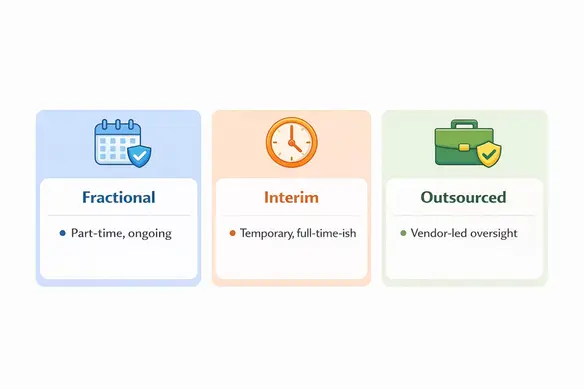
A fractional CTO is a senior technology leader who works with your company on a part-time or defined-scope basis. The role is ongoing enough to create continuity, but not structured like a full-time executive hire. SeeSaw Labs defines a fractional CTO as an experienced technology executive who aligns architecture, security, team structure, and delivery practices with business goals on a part-time or project basis. Their broader guide also describes the role as one of senior judgment that sits between strategy and execution, rather than as extra engineering capacity.
In practical terms, this model works well when the business needs real technical leadership but does not yet require 40 hours a week of executive ownership. That may include roadmap prioritization, architecture decisions, hiring plans, DevOps improvement, vendor evaluation, security and compliance readiness, or delivery management.
The biggest strength of a fractional CTO is the leverage it provides. You get senior decision-making where it matters most, without paying for executive capacity you do not yet fully need. This is why the model often fits startups and growing product companies especially well. Even many external comparison pages describe fractional CTO support as part-time, ongoing, and best suited for early-stage or strategy-heavy environments rather than pure crisis response.
What An Interim CTO Is Designed To Do
An interim CTO is different in one key way. The role is not mainly about flexible ongoing support. It is about temporary executive ownership during a defined transition.
That transition could be a leadership gap, a turnaround, rapid post-funding scale, M&A diligence, team instability, or a period when the company needs a high-accountability technology leader immediately. Current sources consistently describe interim CTOs as short-term but more fully engaged leaders, often brought in for a few months to stabilize, lead, and hand off.
This model is usually the right answer when the stakes are too high for part-time oversight. If your CTO just left, production is unstable, the engineering team is losing confidence, or investors need a credible technical operator in place fast, interim leadership can make sense.
What it is not ideal for is routine stage-based guidance where the company mainly needs clarity, prioritization, and stronger systems over time. Interim support carries greater intensity and usually higher cost because the business is seeking decisive, near-full ownership.
What Outsourced CTO Services Usually Look Like
Outsourced CTO services usually sit closer to external delivery support than to an embedded executive partnership, though the exact structure varies by provider.
Some outsourced CTO models come from agencies or development firms. In those cases, the service may include technical direction, delivery oversight, tooling choices, architecture input, and vendor or development-team management. SeeSaw Labs’ older outsourced CTO guide also frames CTO outsourcing around technology strategy, customer requirements, systems creation, and the broader talent pool that external support can offer.
The value of outsourced CTO services is often speed, flexibility, and access to execution support. This can work well if you are already using a dev shop, need outside oversight, or want a structured external engagement with defined deliverables. Several current pages describe outsourced CTO services this way, especially in environments where companies want external leadership without building a senior in-house layer too early.
The tradeoff is independence. If the outsourced CTO is closely aligned with the vendor delivering, their incentives may not always align with yours. That does not make the model wrong. It just means founders should be clear about whether they want leadership integrated with execution or leadership that can independently challenge execution decisions.
Fractional CTO Vs Interim CTO Vs Outsourced CTO: The Real Differences
On the surface, these models can look similar because all three give you access to senior technical leadership without immediately hiring a permanent full-time CTO. In practice, the differences are much more meaningful.
A fractional CTO is usually best when you need sustained, part-time leadership. The company has a team, a product, or a roadmap, but needs sharper technical direction, cleaner prioritization, stronger architecture, or better delivery discipline.
An interim CTO is usually best when something important must be stabilized fast. The role is more temporary, but also more immediate and more fully accountable.
An outsourced CTO is usually best when you want externally delivered technical leadership, often alongside vendor or development oversight, and are comfortable with a more service-based model.
The most useful way to compare them is not by label, but by four decision factors.
First, time commitment. Fractional is generally part-time and ongoing. Interim is more full-time and temporary. Outsourced varies depending on the scope and provider.
Second, ownership level. Interim holds the highest level of immediate ownership during a transition. Fractional creates strategic ownership without requiring full-time executive bandwidth. Outsourced often owns deliverables or oversight more than long-term internal leadership.
Third, stage fit. Fractional tends to fit early-stage and scaling companies that need direction without full executive overhead. Interim fits high-pressure transition periods. Outsourced fits companies comfortable with an external service model, especially when development execution is already external or fragmented.
Fourth, independence. Fractional support is often strongest when you want an embedded advisor-operator who can challenge assumptions and make decisions in the company’s interest. Outsourced models can be very effective, but founders should check whether the leadership layer is independent from the delivery engine.
Which Model Fits Your Stage Best
Pre-Seed To Early Seed
If you are still shaping the product, validating architecture choices, hiring your first engineers, or translating business goals into a technical roadmap, a fractional CTO is usually the best fit.
At this stage, there often is not enough CTO work for a full-time executive, but there is more than enough risk to justify senior judgment. You need direction, not just output. Current comparison pages repeatedly position fractional CTO support as the right model for early-stage companies that need strategy and architecture guidance without full-time cost.
Seed To Series A Or Early Growth
This is often the strongest zone for fractional CTO support as well. The product exists, the team is growing, and the cost of poor technical decisions is rising. Roadmap discipline, team design, DevOps, security, and delivery quality are starting to matter a lot more.
Leadership Gap Or Technical Crisis
If the business has lost a CTO, is undergoing a major replatforming, is heading into due diligence, or is facing serious engineering instability, interim CTO services are usually the stronger fit. This is where you need someone to take the wheel, not just advice from the passenger seat.
Vendor-Led Or Outsourced Build Environment
If your product delivery is already handled by an external team and you need outside oversight, structure, and accountability, outsourced CTO services can make sense. This is especially true for non-technical founders who need someone to translate business goals into technical execution and manage vendors more confidently.
How To Decide Based On Urgency, Team, And Delivery Risk
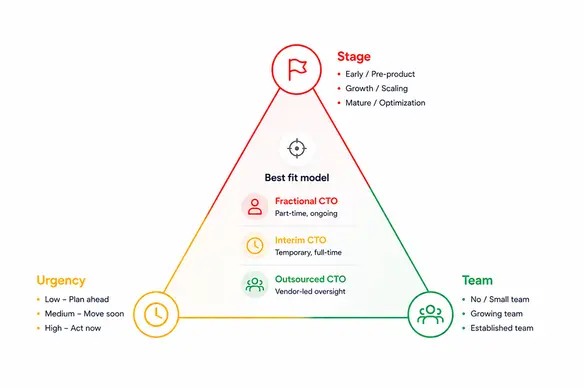
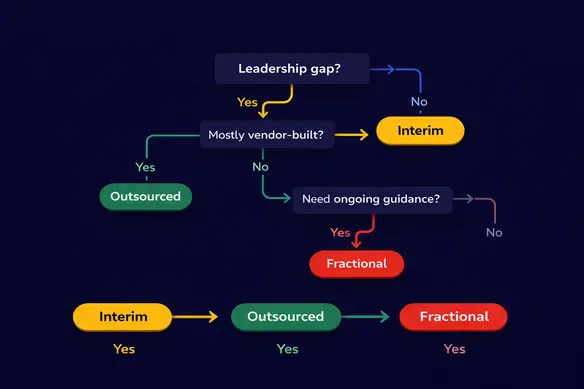
If your company has a functioning team but a weak technical direction, choose fractional.
If your company is in transition, has a leadership vacuum, or is facing a real operational fire, choose an interim.
If your company relies heavily on external development and needs service-based technical oversight, outsourced CTO services may be the better path.
There is also one more filter that matters: what happens after the immediate problem is solved?
If you want a long-term thinking partner who can grow with the business, a fractional model often creates the best continuity. If you mainly need a stabilizer, an interim is more appropriate. If you need a structured external service layer, outsourcing can work well, but you should define boundaries clearly so strategy, delivery, and accountability do not blur together.
Why Fractional CTO Support Is Often The Smartest Middle Ground
For many growing companies, the fractional model is the most practical fit because it addresses the common middle-stage problem.
The business is no longer too early for technical leadership, but not yet ready for a full-time CTO hire. It needs better decisions now, stronger operating discipline, and a more mature technology roadmap, but without committing to executive overhead that may be premature. That is exactly how SeeSaw Labs positions its fractional CTO service: senior-level technical leadership without the full-time cost, embedded across architecture, security, delivery, DevOps, team design, and roadmap execution.
That model is especially compelling when you need someone who can work across leadership, product, engineering, and vendors without turning every problem into a new hire or a new agency engagement. It gives you flexibility, continuity, and strategic depth at a stage where those three things matter more than a title alone.
Frequently Asked Questions
What Is The Difference Between A Fractional CTO And An Interim CTO?
A fractional CTO is usually part-time and ongoing, while an interim CTO is usually temporary, more full-time, and transition-focused. Fractional support is ideal for companies that need sustained technical leadership without the full executive overhead. Interim support fits companies facing leadership gaps, crises, or major change.
Are Outsourced CTO Services The Same As Fractional CTO Services?
Not always. They can overlap, but outsourced CTO services are often delivered through an agency or service provider and may include oversight of execution. Fractional CTO support is more often positioned as embedded, ongoing leadership focused on independent technical direction.
Which Model Is Best For A Startup?
For many startups, especially early-stage or early-growth companies, fractional CTO support is usually the strongest fit because it brings senior judgment without the cost or capacity assumptions of a full-time executive.
When Should A Company Hire An Interim CTO?
An interim CTO makes the most sense during a leadership vacancy, a technical crisis, an M&A period, a major transformation, or a phase when the company needs temporary but high-accountability executive ownership.
Can A Fractional CTO Become A Full-Time CTO Later?
Yes, that can happen. Some providers explicitly describe the fractional model as something that can later transition into a full-time role if the company and leader are a strong fit.
Conclusion
Choosing between a fractional CTO, an interim CTO, and outsourced CTO services is not really about which label sounds more impressive. It is about matching the leadership model to the stage your company is actually in.
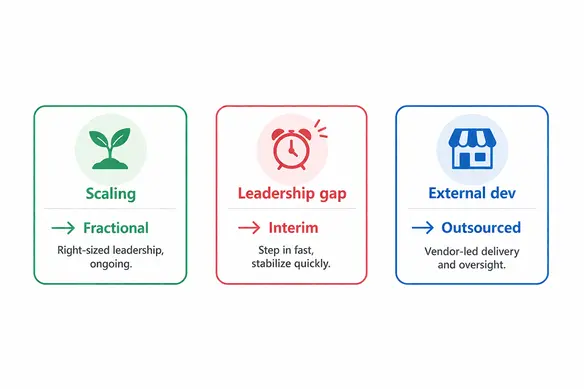
If you need ongoing strategic technical leadership without full-time overhead, fractional CTO support is usually the right move. If you need someone to step in fast and fully lead through a transition, interim CTO services are a better fit. If your environment is more vendor-driven and you need external oversight tied to execution, outsourced CTO services can make sense.
For many startups and scaling product companies, the smartest choice is often the middle ground. A strong fractional CTO brings the clarity, direction, and delivery discipline needed to help the business grow without overcommitting too early.
Key Takeaway
- Fractional CTO support is usually best for early-stage and scaling companies that need ongoing, part-time senior technical leadership.
- Interim CTO services are best for leadership gaps, crisis periods, major transitions, or high-stakes temporary execution.
- Outsourced CTO services are often best when a company wants external technical oversight, especially in vendor-led or agency-led delivery environments.
- The right decision depends less on title and more on stage, urgency, independence, and delivery risk.
- For many companies, a fractional CTO is the most practical and scalable fit because it gives senior leadership without premature executive overhead.