What Does A Fractional CTO Do Week-To-Week? A Realistic Operating Cadence For Founders
SeeSaw Labs//7 Min Read
Learn what a fractional CTO does week to week, including meetings, decision points, deliverables, and a realistic cadence founders can run.

Introduction
If you have ever hired “senior technical leadership” and still felt that decisions were slow, priorities were fuzzy, and delivery remained unpredictable, the problem is usually not effort. It is cadence.
A fractional CTO works best when there is a repeatable rhythm for decisions, delivery, and risk. Not more meetings, just the right few, tied to real outputs your team can execute.
This article breaks down what a fractional CTO does week to week, what the fractional CTO role should own, what your team should own, and a realistic operating cadence founders can use immediately.
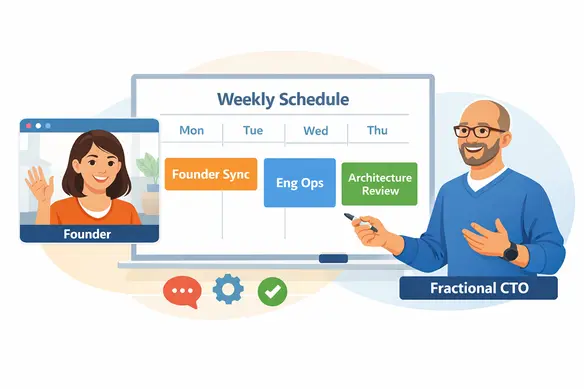
Table Of Contents
- What The Fractional CTO Role Owns (And What It Does Not)
- The Weekly Cadence That Keeps Teams Shipping
- A Sample Week Schedule You Can Copy
- The Weekly Outputs You Should Expect
- Monthly And Quarterly Rituals That Prevent Surprises
- How SeeSaw Labs Runs Fractional CTO Engagements
- FAQs
- Conclusion
What The Fractional CTO Role Owns (And What It Does Not)
A good fractional CTO is not your most expensive senior engineer. They are your leverage point: strategy, governance, architecture stewardship, and leadership coaching that turns part-time into full-time impact.
Fractional CTO Responsibilities You Should Expect
These are common fractional CTO responsibilities across strong guides, and they show up in real engagements:
- Translate business goals into a technical roadmap and delivery plan
- Own or chair architecture decisions and scaling direction
- Set delivery discipline: milestones, risk controls, and measurable progress
- Build and scale the engineering team: roles, hiring loops, mentorship
- Raise security and compliance readiness when it matters
- Evaluate vendors, tools, and platforms, then prevent tool sprawl
What A Fractional CTO Should Usually Not Do
This is where many founders accidentally burn budget:
- Run every standup by default
- Review every pull request
- Become the ticket triage person
- Act as your day-to-day engineering manager unless you have no internal leadership
The fractional CTO is a leverage role, and daily standups should be run by engineering managers, with CTO attendance only when metrics are persistently “red.”
The Weekly Cadence That Keeps Teams Shipping
The goal of the cadence is simple: create a predictable loop in which priorities are set, decisions are documented, delivery is unblocked, and risk is addressed early.
A practical cadence often looks like this:
- One founder syncs to align priorities and tradeoffs
- One engineering ops sync to keep delivery honest with metrics
- One architecture review slot (weekly or biweekly, depending on change rate)
- Async decision-making with a written log (so you stop re-litigating choices).
A Sample Week Schedule You Can Copy
This example assumes a founder-led company with a fractional CTO engaged 1 to 2 days a week.
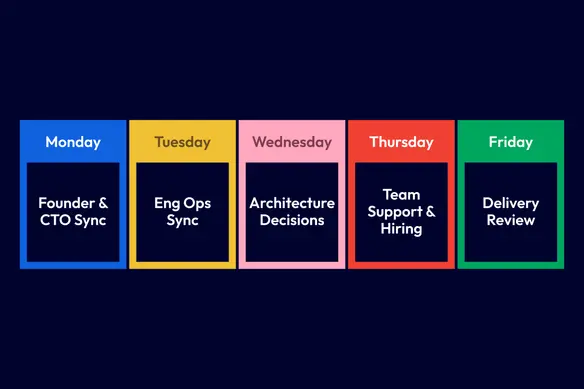
| Day | Cadence Touchpoint | What Happens | Output |
|---|---|---|---|
| Monday | Founder And CTO Priorities Sync (30 to 45 min) | Confirm top outcomes for the week, decide tradeoffs, unblock decisions | Updated weekly priorities, decision list |
| Tuesday | Engineering Ops Sync (30 min) | Review delivery health and risks, unblock cross-team issues | Action list, owners, dates |
| Wednesday | Async Architecture Decisions | Review proposed changes that affect core systems | Logged architecture decision record |
| Thursday | Team Support And Hiring Block (60 to 90 min) | Mentorship, hiring pipeline review, role clarity | Hiring next steps, leveling notes |
| Friday | Delivery Review And Next Week Setup (30 min) | Confirm what shipped, what slipped, why, and what changes next week | Weekly recap, updated backlog |
If your team is in a fragile state (incidents, missed deadlines, high churn), you temporarily tighten the loop. If things stabilize, you keep the cadence but reduce meeting weight.
The Weekly Outputs You Should Expect
If you are asking “what does a fractional CTO do,” the cleanest answer is: they turn ambiguity into documented decisions and predictable delivery.
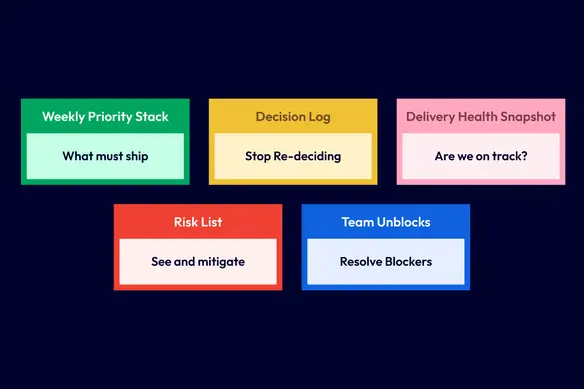
Here are weekly artifacts that matter:
1) A Clear Weekly Priority Stack
Not a long roadmap, a short list: what must ship, what must not slip, and what gets cut if reality hits.
SeeSaw Labs explicitly positions fractional CTO work around roadmapping, delivery management, and clarity across technical decisions.
2) A Decision Log (So You Stop Re-Deciding)
When architecture and platform choices are not written down, teams burn cycles re-arguing context.
Using Architecture Decision Records (ADRs) is a lightweight, proven way to capture a decision, the context, and consequences.
3) Delivery Health Snapshot Using A Few Real Metrics
Weekly is enough to spot drift early.
DORA’s metrics are widely used to track software delivery speed and stability, including indicators like change fail rate and related instability measures.
4) A Running Risk List
One page is fine. The point is visibility:
- Security gaps
- Scaling constraints
- Vendor dependencies
- Compliance exposure
- Single points of failure
5) Unblocking Work That Only A CTO Can Do
Examples:
- Setting decision rights
- Defining guardrails for production-impacting changes
- Stopping platform sprawl
- Clarifying who owns incident response and escalation
Monthly And Quarterly Rituals That Prevent Surprises
Week to week keeps delivery moving. Monthly and quarterly is how you prevent painful “surprise rewrites” and board-level panic.
Monthly: Architecture Review And Debt Tradeoffs**
Monthly architecture review where significant design decisions are proposed and logged, and risk registers updated.
Monthly: Cloud Cost And Tooling Review
If cloud spend is drifting, it should surface as a recurring review item, not a quarterly shock.
Quarterly: Leadership Update In Business Language
Even if you do not have a board, you still need a quarterly “tech state of the union” that covers:
- Roadmap health
- Security posture
- Capacity forecast
- Material risks
How SeeSaw Labs Runs Fractional CTO Engagements
One reason fractional CTO engagements fail is that they never move from advice to a repeatable operating system.
SeeSaw Labs structures engagements through its 5D process:
- Discover: goals, architecture, pain points
- Define: roadmap with measurable outcomes and budget guardrails
- Design: scalable systems and delivery processes
- Develop: lead teams, remove blockers, drive measurable sprint progress
- Delight: launch support plus a 90-day optimization plan
If your main constraint is capacity, not leadership, SeeSaw Labs also offers Staff Augmentation so CTO time stays focused on high-leverage decisions, not extra hands work.
FAQs
What Does A Fractional CTO Do On A Weekly Basis?
They align weekly priorities with business goals, unblock decisions, monitor delivery health, document key technical choices, and coach the team so execution improves without constant escalation.
How Many Hours Per Week Is Typical For A Fractional CTO?
It varies by need, but many engagements are structured around 1 to 3 days per week, especially for growing teams that need ongoing leadership without a full-time hire.
What Are The Core Fractional CTO Responsibilities Founders Should Expect?
Common responsibilities include technology roadmapping, architecture and platform selection, security and compliance readiness, team design and hiring, and delivery management.
How Is A Fractional CTO Role Different From A Consultant?
A consultant is often engaged for a bounded problem. A fractional CTO typically provides continuous leadership, governance, and decision-making across weeks and months.
How Do You Measure Whether The Cadence Is Working?
Look for clearer decisions, fewer repeated debates, improved delivery stability, and better visibility into risks. Using a small set of delivery metrics can help spot improvements or drift early.
Conclusion
A fractional CTO creates value when your company runs on a simple rhythm: decide, document, ship, measure, and improve. Week to week, that means founder alignment, engineering ops visibility, architecture decisions that do not get re-litigated, and unblocking that protects delivery.
Key Takeaways
- A fractional CTO’s week-to-week work is mostly decision-making, delivery governance, and team enablement, not constant hands-on coding.
- A realistic cadence includes a weekly founder sync, a weekly engineering ops sync, and a lightweight decision log for architecture and tooling.
- Track a small set of delivery and stability signals consistently so issues surface early, not after a missed launch.
- If you want an embedded cadence built to bridge strategy and execution, SeeSaw Labs’ Fractional CTO Services are designed around a repeatable process and measurable progress.