Hire A Fractional CTO: Interview Questions, Red Flags, And Reference Checks
SeeSaw Labs//13 Min Read
Learn how to hire a fractional CTO with the right interview questions, red flags, and reference checks so you choose a leader who fits your stage.

Introduction
A bad technical hire rarely shows up as bad in the first meeting.
In fact, the most expensive mistakes often begin with a candidate who sounds confident, says the right buzzwords, and promises immediate clarity. The problem is that hiring a fractional CTO is not the same as hiring a developer, an engineering manager, or a consultant who gives occasional advice. You are hiring a senior leader who is expected to shape decisions, reduce risk, and help the business move forward with greater confidence.
That is why the hiring process matters so much. A strong fractional CTO can help bring order to product decisions, architecture, delivery, hiring, and scale. A weak one can leave you with more meetings, more opinions, and very little real progress.
If you are trying to hire a fractional CTO, this guide will help you ask better interview questions, spot early red flags, and run reference checks that tell you more than whether someone is “great to work with.” That matters because the best fractional CTO relationships are built around fit, decision quality, and measurable outcomes, not just technical pedigree. SeeSaw Labs Fractional CTO engagement is built exactly around that mix of business alignment, architecture, security, delivery, and 90-day execution planning.
Table Of Contents
- Why Hiring A Fractional CTO Is Different From Hiring A Developer
- What a Good Fractional CTO Fit Looks Like
- Interview Questions To Ask Before You Hire A Fractional CTO
- Red Flags That Show Up In Interviews Early
- How To Run Reference Checks That Actually Reduce Risk
- What To Confirm Before You Sign An Engagement
- When To Choose A Fractional CTO Consultant Instead Of A Full-Time Hire
- Why SeeSaw Labs Is A Strong Fit
- Frequently Asked Questions
- Conclusion
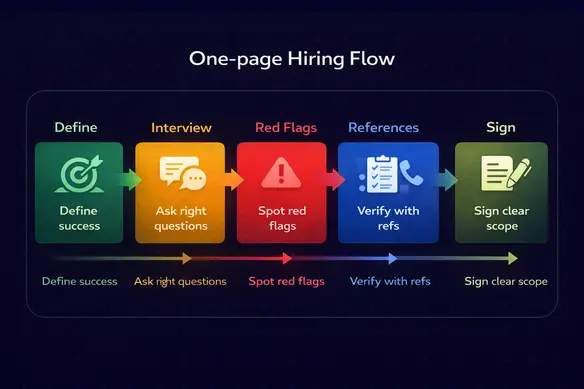
Why Hiring A Fractional CTO Is Different From Hiring A Developer
A fractional CTO is not extra coding capacity.
That distinction matters because many companies start the search with the wrong expectation. They think they are hiring a very senior engineer who can also join leadership calls. In practice, the role is much broader. SeeSaw Labs’ fractional CTO positioning describes it as part-time executive technology leadership that aligns business goals with architecture, security, hiring, and delivery. Its newer guide makes the same point more directly: this is a decision-making role that sits between strategy and execution, not just development output.
That is why the hiring bar should be different.
You are not just asking whether this person understands systems. You are asking whether they can improve prioritization, guide teams, challenge weak assumptions, and help leadership make better technical tradeoffs. If you screen only for technical fluency, you can end up with someone who sounds impressive but does not know how to create momentum in a real business.
What a Good Fractional CTO Fit Looks Like
Before you interview candidates, it helps to define what success actually looks like for your business.
A good fractional CTO fit usually has three parts. First, they have experience relevant to your stage. Second, they can explain how they create outcomes in a limited time. Third, they are comfortable operating with a clear scope, clear decision rights, and a defined engagement model. Several current hiring and comparison pages highlight the same ideas in different languages, including stage fit, 90-day clarity, and clearly defined ownership.
That means a good candidate should be able to answer questions like these clearly.
What kinds of companies do you work best with?
What do you usually fix first?
What outcomes should we expect in the first 30, 60, and 90 days?
How do you divide your time between strategy, execution, team leadership, and firefighting?
What decisions do you expect to own, influence, or recommend?
If those answers stay vague, the risk is usually not a lack of intelligence. It is a lack of clarity in operations.
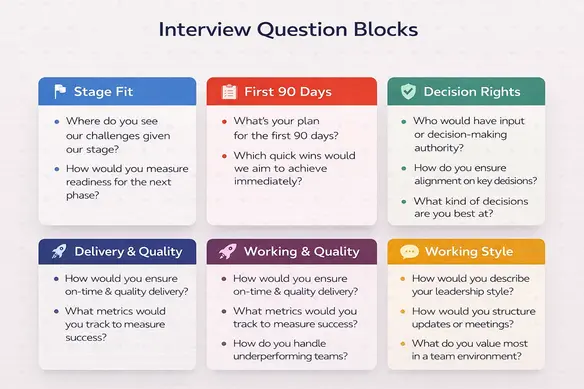
Interview Questions To Ask Before You Hire A Fractional CTO
The best interviews do not try to turn into technical trivia contests. They pressure-test judgment, communication, and fit.
1. What Types Of Companies And Growth Stages Are Your Best Fit? This is one of the most important questions because stage mismatch is a common reason these engagements fail. Multiple current sources stress that stage fit matters more than generic seniority. A candidate who is strong in enterprise modernization may not be the right fit for a startup that needs fast product decisions, and a candidate who thrives in seed-stage ambiguity may not be ideal for a later-stage team needing formal process.
2. In Your First 30, 60, And 90 Days, What Would You Typically Assess And Change? This helps you distinguish between structured operators and abstract advisers. SeeSaw Labs anchors its Fractional CTO offering around discovery, roadmap definition, delivery alignment, and a 90-day optimization plan. A strong candidate should be able to describe a similar progression in concrete terms.
3. How Do You Decide What Needs Leadership Attention First? You want to hear how they prioritize architecture, delivery, hiring, security, product risk, and technical debt. Good answers sound like sequencing. Weak answers make it sound as if everything is equally urgent.
4. Tell Me About A Time You Joined A Team With Weak Technical Direction. What Changed Because You Were There? This question forces the candidate to talk about commercial impact, not just activity. One of the clearer red flags surfaced in current hiring guidance is when candidates cannot explain the business impact of prior work in simple terms.
5. How Do You Work With Founders, Product Leaders, And Engineering Managers Who Disagree? A fractional CTO has to operate across functions. You are looking for someone who can create clarity, not just win technical arguments.
6. What Decisions Do You Believe A Fractional CTO Must Be Able To Influence Directly? This is a very important filter. A Fractional CTO must highlight a major structural failure mode: no decision rights, but full accountability. If the person cannot influence staffing, priorities, architecture direction, or delivery tradeoffs, they may not be able to create outcomes, no matter how experienced they are.
7. What Would Make You Tell A Client Not To Hire You?
This is a strong honesty test. Good candidates usually know what is outside their best-fit zone.
8. How Do You Measure Whether An Engagement Is Working?
You want answers tied to roadmap clarity, release confidence, team performance, architecture decisions, hiring quality, delivery stability, or cost and risk visibility. You do not want “better strategy conversations” as the only outcome.
9. How Much Of Your Time Typically Goes To Strategy Versus Firefighting?
A fractional CTO should point toward a healthier balance, with most effort going into architecture, velocity, security, and leadership coaching rather than constant reactive work. That makes this a useful way to test whether the candidate expects to lead or mostly just rescue.
10. How Do You Approach Hiring, Vendor Selection, And Technical Due Diligence?
Current market commentary on fractional CTO work repeatedly highlights hiring, vendor evaluation, and diligence as high-leverage areas where strong judgment matters. That makes this a useful, practical question, especially for non-technical founders.
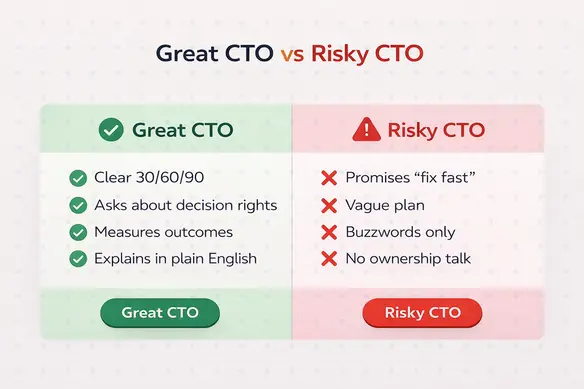
Red Flags That Show Up In Interviews Early
A polished candidate can still be the wrong hire. These warning signs are worth taking seriously.
They Promise To Fix Everything Quickly
This is one of the clearest repeat red flags in current hiring content. Overselling before diagnosis usually signals shallow thinking. Strong candidates tend to ask sharper questions before they prescribe.
They cannot Explain Their Plan In Plain Language
If a candidate cannot explain what they do in practical business terms, that matters. Fractional CTO engagements depend on communication across technical and non-technical stakeholders. Several current hiring guides call out overly vague answers and failure to simplify as early warning signs.
They Have No Clear 90-Day Model
When candidates talk only in broad themes like transformation, modernization, or strategy, but cannot describe what happens first, the engagement is more likely to drift. Current interview resources repeatedly highlight vague onboarding answers as a red flag.
They Do Not Ask About Decision Rights
This one gets overlooked. If a candidate never asks who makes technical decisions, who owns priorities, or how cross-functional conflict gets resolved, they may not fully understand how fractional leadership actually succeeds.
They Lack Relevant Stage Experience
A highly capable CTO can still be the wrong fit if most of their experience comes from companies with very different constraints. Several current hiring guides stress stage relevance as a core evaluation factor, not a nice-to-have.
They Sound Like A Vendor Pitch, Not A Leadership Partner
If every answer quickly moves toward team augmentation, delivery hours, or a stack recommendation, be careful. You may be talking to someone who is more comfortable selling execution than owning leadership outcomes.
How To Run Reference Checks That Actually Reduce Risk
Reference checks are where many teams get lazy.
A weak reference process usually asks broad questions like, “Were they good?” or “Would you work with them again?” That rarely tells you much. Better reference checks focus on behavior, working style, scope, and outcomes. General hiring guidance and executive reference-check advice both stress that inconsistencies, ignored warning signs, and vague praise should be treated carefully rather than brushed aside.
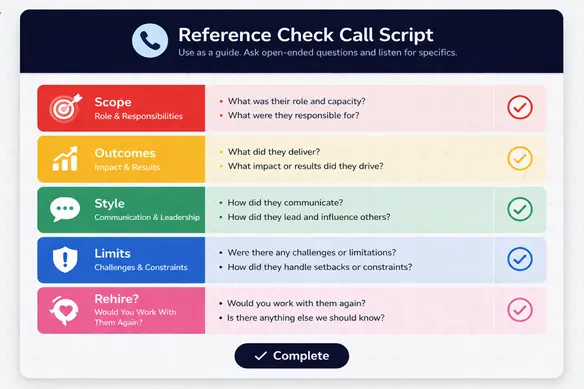
A better reference process for a fractional CTO consultant should cover five things:
Ask About Scope
Was this person truly operating at the CTO level, or were they mainly advising around a narrow technical issue?
Ask About Outcomes
What changed because they were involved? Did roadmap clarity improve? Did delivery improve? Did leadership make better decisions? Did the team become less dependent on chaos?
Ask About Working Style
Were they practical? Were they responsive at the right moments? Did they simplify complexity or add more of it? Did they work well with founders and non-technical stakeholders?
Ask About Limits
What kinds of environments were they not ideal for? What type of company should not hire them?
Ask About Rehire Risk
If you were hiring again at a similar stage, would you bring them back? Why or why not? That last question often produces more honest nuance than generic praise.
What To Confirm Before You Sign An Engagement
Even a good candidate can become a weak engagement if the structure is wrong.
Before signing, confirm the scope, cadence, and decision model. SeeSaw Labs’ Fractional CTO framing is helpful here because it emphasizes discovery, defined outcomes, architecture options, delivery alignment, and post-launch optimization rather than loose advisory time. That is the right pattern to look for.
Make sure these points are clear:
- What problems are in scope for the first phase?
- What outcomes should be visible in the first 30, 60, and 90 days?
- Which decisions does the fractional CTO own, influence, or recommend?
- How often does leadership review progress?
- What access do they need to teams, systems, and data?
- What would count as an early success signal?
If those basics are not clear, the risk is not just confusion; it is paying for senior time without creating the conditions for results.
When To Choose A Fractional CTO Consultant Instead Of A Full-Time Hire
Many companies do not need a full-time CTO as early as they think they do.
SeeSaw Labs’ current guidance frames fractional support as the right fit when a company needs senior judgment now, but not a full-time executive seat yet. Other current market commentary makes a similar point: the value of a fractional CTO lies in pattern recognition, operating leverage, and focused senior leadership at a stage when a permanent full-time hire may be premature.
This model often makes sense when:
- The company needs better technical direction, but not forty hours a week of executive bandwidth,
- The founder needs help evaluating architecture, hiring, or vendors.
- The product has grown beyond MVP-era decision-making,
- The team needs leadership across the roadmap, delivery, and scale.
- or the company wants stronger execution before committing to a permanent executive hire.
Why SeeSaw Labs Is A Strong Fit
This topic fits SeeSaw Labs especially well because the company is already positioned around the outcomes buyers actually care about when they hire a fractional CTO.
The service page emphasizes embedded leadership across architecture, DevOps, hiring, security, delivery, and measurable roadmapping, supported by a 5D process and a 90-day optimization plan. The newer guide also reinforces that the role is about aligning technology with business goals and helping teams execute with clarity. That makes SeeSaw Labs well-suited to a hiring-focused article that helps buyers look for judgment, structure, and results rather than just impressive resumes.
Frequently Asked Questions
How Do I Hire A Fractional CTO The Right Way?
Start by defining your stage, your current bottlenecks, and what success should look like in the first 90 days. Then, interview for judgment, communication, decision-making, and relevant stage experience, not just technical knowledge.
What Should I Ask In A Fractional CTO Interview?
Ask about stage fit, 30-60-90 day priorities, decision rights, cross-functional leadership, measurable outcomes, and examples of past impact. Good interview guides in the current market repeatedly emphasize those areas, even when they phrase them differently.
What Are The Biggest Red Flags When Hiring A Fractional CTO?
The clearest red flags are overselling without diagnosis, vague first-phase plans, weak communication, lack of relevant stage experience, and accepting accountability without clarifying decision rights.
How Important Are Reference Checks For A Fractional CTO Consultant?
They are very important because the role is senior, cross-functional, and trust-based. Good reference checks help you verify scope, impact, working style, and whether the candidate created real outcomes or just looked credible in the interview.
Can A Fractional CTO Help Hire My Engineering Team Too?
Yes. Current market guidance often points to hiring support as one of the highest-leverage areas where a strong fractional CTO can help define roles, run technical screens, and avoid costly early mistakes.
Conclusion
Hiring a fractional CTO is not about finding the smartest person in the room. It is about finding the right operator for your stage, your team, and the decisions in front of you.
The best candidates do not just speak confidently. They bring structure. They clarify priorities. They know how to work inside limited time. They understand where decision rights matter. They can show past outcomes, explain their approach in plain language, and survive a thoughtful reference process.
Key Takeaway
- Hire for stage fit, not just technical pedigree.
- Ask interview questions that test judgment, communication, and first-phase priorities.
- Treat overselling, vague plans, and unclear ownership as real red flags.
- Use reference checks to verify outcomes, working style, and limits, not just general likeability.
- Choose a fractional CTO partner who can connect business goals to technical execution with clear accountability.