Outsourced CTO Services: When, Who, and How to Hire the Right Fit
SeeSaw Labs//11 Min Read
Learn when outsourced CTO services make sense, what to expect in the first 30, 60, and 90 days, and how to hire the right technical leader.

Introduction
At some point, every growing company hits the same wall. The product is moving, customers are asking for more, and technical decisions start stacking up faster than the team can safely make them.
That is usually when founders and operators realize they do not just need more engineers. They need leadership, someone who can set direction, reduce risk, and keep delivery moving.
That is where outsourced CTO services come in. This guide covers when to bring one in, who to hire, and how to structure the relationship so it actually works.
What Outsourced CTO Services Mean In 2026
Outsourced CTO services give you senior technical leadership without the overhead of a full-time executive. You get strategy, architecture direction, and execution management, usually on a part-time or scoped engagement.
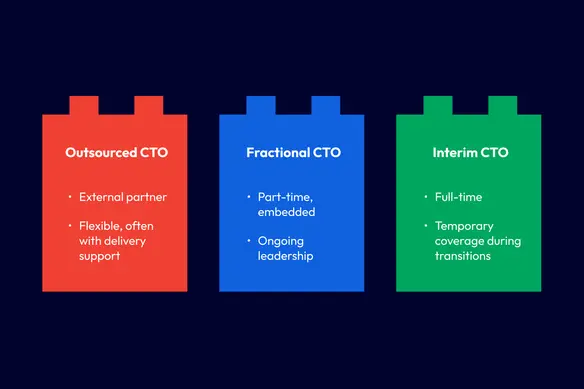
Outsourced CTO Vs Fractional CTO Vs Interim CTO
- Outsourced CTO: Typically delivered by an external partner or consultancy, often flexible and on-demand, sometimes packaged with delivery support.
- Fractional CTO: Part-time CTO leadership embedded into your business rhythm, usually recurring, often focused on strategy and accountability, not just task execution.
- Interim CTO: Temporary full-time leadership for a defined period, usually during transitions like resignations, re-orgs, or acquisitions.
Outsourced CTO Vs Outsourced IT Support
An outsourced IT provider usually focuses on operational IT, helpdesk, networks, device management, and reactive support. CTO leadership focuses on product and platform strategy, engineering execution, and technical risk management.
If your biggest pain is “our laptops and systems are constantly breaking,” that is IT support.
If your pain is “we cannot ship reliably, our architecture is shaky, and security reviews are stressful,” that is CTO territory.
When To Outsource A CTO
The right time is less about company size and more about complexity and risk. Here are the most common signals.
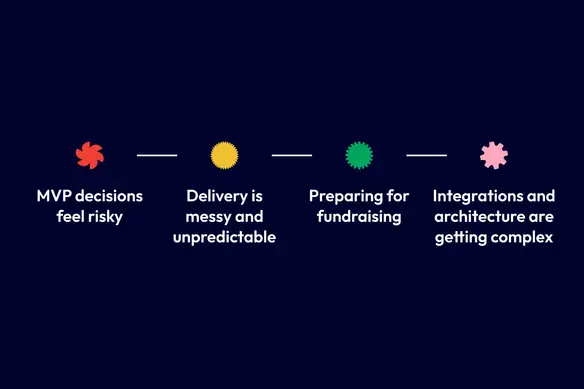
You Are Building An MVP And Need To Avoid Expensive Mistakes
Early decisions about architecture, stack, and delivery process can either accelerate you for a year or trap you in rework. An outsourced CTO can help define a realistic roadmap and make trade-offs that align with your timeline and budget.
You Have A Working Product, But Delivery Is Getting Messy
Common symptoms include:
- Sprints feel chaotic, and priorities change without clarity
- Releases are unpredictable
- Bugs and tech debt keep winning
- Engineers disagree on direction, and no one is accountable
A CTO helps turn “busy” into “progress,” with a plan the whole team can execute.
You Are Preparing For Fundraising Or Enterprise Sales
Investors and enterprise buyers ask uncomfortable questions: security posture, reliability, scalability, and the credibility of technical leadership. Many outsourced CTO guides call out this stage as a common trigger because technical risk becomes business risk.
You Need A Strong Integration Strategy
Integrations can quietly become the most expensive part of building software, especially when you need reliability, monitoring, and long-term maintainability. If you are integrating tools, legacy systems, or multiple vendors, CTO-level oversight saves time and reduces risk.
You Are Hiring Your First Internal Engineering Leaders
An outsourced CTO can define roles, interview candidates, and set up processes so your early hires do not inherit chaos. SeeSaw Labs includes team design and hiring support as part of its Fractional CTO offering.
Who To Hire: Individual, Firm, Or Fractional CTO Team
You have three realistic options.
Option 1: An Independent CTO Consultant
Best when you need strategic leadership, and you already have a capable delivery team.
Watch-outs:
- One person can only cover so much
- If they disappear, momentum disappears with them
Option 2: A CTO Services Firm Or Studio
Best when you want leadership plus access to supporting specialists, like architecture, security, delivery management, and hands-on engineers.
This model often works well when you need both direction and execution, without hiring a full internal leadership stack.
Option 3: A Fractional CTO Embedded Partner
Best when you want ongoing leadership that plugs into your weekly cadence and stays accountable to outcomes. SeeSaw Labs positions Fractional CTO support as embedded technical leadership that bridges business goals and engineering execution.
What You Should Expect In The First 30, 60, And 90 Days
A strong outsourced CTO engagement should not be vague. You should see concrete outputs early, then the compounding value over time.
Many modern fractional CTO playbooks recommend asking for a 30/60/90-day plan because it forces clarity on priorities and outcomes.
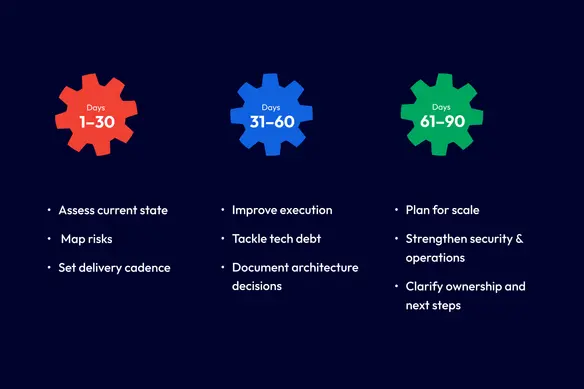
Days 1 To 30: Clarity, Baselines, And Risk Reduction
You should expect:
- A current-state assessment of architecture, repo health, deployment, and delivery workflow
- A prioritized risk list (security, reliability, scalability)
- A simple technical roadmap aligned to business goals
- A delivery cadence that the team can actually maintain
- Immediate fixes for the highest-risk bottlenecks
Days 31 To 60: Execution Improvements And Platform Guardrails
You should expect:
- A plan to reduce tech debt in the critical path
- Better release predictability through process and tooling improvements
- Architecture decisions documented, with tradeoffs and next steps
- Hiring plan support if needed (roles, interviews, onboarding strategy)
Days 61 To 90: Scale Readiness And Accountability
You should expect:
- A 90-day delivery plan tied to measurable outcomes
- Stronger operational maturity (monitoring, incident readiness, ownership)
- Clear ownership boundaries between the internal team and external partners
- A plan for what happens next, including transition to in-house leadership if that is the goal
How To Hire An Outsourced CTO
This is the practical process that saves you from “we hired someone impressive, but nothing changed.”
Step 1: Define The Job You Actually Need Done
Write this in plain language:
- What you are building or scaling
- The next 6 months of outcomes you need
- The risks that keep you up at night (security, reliability, hiring, speed)
Step 2: Choose The Engagement Model
Common models include:
- Advisory only (strategy, architecture review, coaching)
- Embedded fractional leadership (weekly cadence, roadmap ownership)
- Project-based CTO leadership (migration, rebuild, security hardening)
- Interim CTO coverage (full-time temporary)
Step 3: Evaluate The CTO On Three Dimensions
- Product and business alignment: can they translate goals into technical priorities?
- Engineering credibility: can they lead strong engineers and make sound tradeoffs?
- Communication and accountability: do they create clarity, or create meetings?
Step 4: Ask These Questions In The Interview
- What would you focus on in your first 30 days, and why?
- Show an example of a technical roadmap you created and how it drove outcomes
- How do you decide when to refactor, rebuild, or live with debt?
- How do you measure engineering effectiveness without micromanaging?
- What is your approach to security in modern product delivery?
Step 5: Watch For Red Flags
- They only talk tools, not outcomes
- They promise timelines without learning your system
- They cannot explain tradeoffs clearly
- They avoid ownership; everything is “it depends.”
- They treat security like a final checklist
Security, Compliance, And Procurement Readiness
Even if you are not in a regulated industry, buyers expect a strong security posture. A CTO should turn security into a system, not a panic response.
Use A Recognized Secure Development Baseline
A practical, credible baseline is NIST’s Secure Software Development Framework (SSDF), which outlines fundamental practices for reducing software vulnerability risk.
For web applications, OWASP ASVS is a widely used reference for testing and verifying security controls.
You do not need to become a standards expert to benefit. The value is having a clear checklist for what “good” looks like, and making it part of delivery.
Plan For Procurement Reality
If you sell to larger customers, you will likely encounter SOC 2 requirements or questionnaires. SOC 2 is a report on controls relevant to security, availability, processing integrity, confidentiality, or privacy.
A capable outsourced CTO helps you prepare evidence, tighten processes, and reduce friction in sales cycles.
Common Mistakes And How To Avoid Them
Mistake 1: Treating The CTO Like A Part-Time Senior Engineer
A CTO’s job is leverage. They should set direction, build systems, and help the team ship better. If you only use them to write code, you lose most of the value.
Mistake 2: Not Defining Decision Rights
You need clarity on:
- Who approves architecture changes
- Who owns vendor selection
- Who signs off on security decisions
- Who is accountable for delivery outcomes
Mistake 3: Leaving Support Out Of The Plan
If no one owns monitoring, incident response, and maintenance, your product will slowly become fragile. Support is part of leadership, not an afterthought.
How SeeSaw Labs Supports CTO Leadership
SeeSaw Labs provides Fractional CTO Services as senior-level technical leadership without the full-time cost, focused on architecture, platform choices, security readiness, hiring, and delivery management.
What that typically looks like in practice:
-
Aligning Tech Strategy With Business Goals
SeeSaw Labs helps translate product goals, timelines, and budget constraints into a realistic technical roadmap, so engineering work stays tied to outcomes rather than just tasks. -
Architecture And Platform Decisions You Can Defend
From choosing the right stack to defining scalable system design, the team supports key architecture decisions early, documents tradeoffs, and creates guardrails that reduce rework as the product grows. -
Security Readiness Built Into Delivery
Security is treated as a delivery system, not a last-minute checklist. That includes setting expectations for access control, audit logging, secure data handling, and release practices that help teams pass security reviews with less scrambling. -
Hiring Support And Team Design
SeeSaw Labs supports hiring by defining roles, creating technical interview processes, evaluating candidates, and helping onboard engineers, so you can build a team structure that scales. -
Delivery Management And Execution Cadence
Fractional CTO support includes establishing a clear operating rhythm, improving sprint planning and prioritization, setting quality expectations, and creating visibility into progress, so releases become more predictable and engineering effort is focused. -
Vendor And Partner Oversight
If your product depends on third-party platforms, integrations, or contractors, SeeSaw Labs can help evaluate vendors, define an integration strategy, and ensure long-term maintainability by defining ownership boundaries and technical standards.
FAQs
What Are Outsourced CTO Services?
Outsourced CTO services provide senior technical leadership through an external partner, typically on a part-time or on-demand basis, covering strategy, architecture, delivery management, and risk reduction.
When Should A Startup Hire An Outsourced CTO?
Common triggers include pre-MVP architecture decisions, post-MVP scaling challenges, fundraising preparation, enterprise security reviews, or unpredictable delivery.
What Is The Difference Between A Fractional CTO And An Outsourced CTO?
In practice, a fractional CTO often implies an embedded, recurring leadership relationship, while an outsourced CTO can mean a broader set of external models, including project-based or firm-delivered leadership.
How Do I Know If I Need A CTO Or Just More Engineers?
If the team is coding but direction is unclear, delivery is inconsistent, security is reactive, or architecture decisions keep changing, you need leadership. If the roadmap is clear and execution is simply under-resourced, you may need staff augmentation.
What Should I Ask For In The First Month?
Ask for a 30-day assessment, a prioritized risk list, and a simple roadmap tied to business outcomes. Many hiring guides recommend requesting a 30/60/90-day plan to force clarity and accountability.
Conclusion
Outsourced CTO services work best when you treat them like leadership, not a shortcut. The goal is to create clarity, reduce risk, and build a delivery system your team can sustain.
If you want an embedded technical partner who can guide architecture, security, hiring, and delivery, explore SeeSaw Labs Fractional CTO Services.
Key Takeaway
- Hire an outsourced CTO when complexity and risk outgrow your team’s current leadership capacity.
- Expect concrete deliverables in the first 30, 60, and 90 days, not just advice.
- Choose an engagement model that matches your stage, advisory, embedded fractional leadership, or interim coverage.
- Make security a built-in system using credible baselines like NIST SSDF and OWASP ASVS.
- Use internal links to connect readers to CTO Services, Staff Augmentation, and your build capabilities